Almost every classroom runs the same vocabulary routine: here are ten words, look them up, copy the definition, use each one in a sentence, quiz on Friday. Most students pass the quiz. Almost none of them use the words afterward. The routine isn’t lazy teaching, it’s just built on a wrong assumption about how words are learned.
The problem with the dictionary definition
Dictionary definitions are written to be precise, not to be understood. A seventh grader who looks up abdicate gets something like “to relinquish formally a high office or responsibility,” which trades one unknown word for two more. They copy it, they can match it on the quiz, and they have learned nothing they can use.
What works instead is a student-friendly definition: plain language, describing what the word means in a situation a child recognizes. Abdicate becomes “to give up a powerful job on purpose, like a king stepping down.” Slightly longer, immediately usable, and it survives the week.
One exposure is never enough
The research consistently finds that a word needs between eight and twelve meaningful encounters before it’s genuinely owned. Not eight repetitions of the same worksheet, but encounters in different contexts. Reading it, hearing you use it, saying it, writing it, seeing it in a new sentence where it means something slightly different.
This is the single biggest reason vocabulary doesn’t stick. A word gets introduced Monday, practiced twice, tested Friday, and never appears again. Three exposures against a requirement of ten.
Six things that work better
1. Teach fewer words, properly
Ten words taught to the level of actual use beats twenty words taught to the level of a quiz. If you have to choose, cut the list rather than the practice.
2. Choose words worth the time
Not every unknown word deserves a week. The ones that pay off are the general academic words that show up across subjects and texts (analyze, contrast, significant, establish, consequence). A word like photosynthesis matters in science and nowhere else; a word like establish shows up everywhere for the rest of their lives.
3. Give examples and non-examples
“A bias is when someone can’t be fair because they already like one side. Cheering for your own team is not bias. Refusing to call a foul on your own team is.” The boundary teaches the word better than the definition does.
4. Make them choose, not just recall
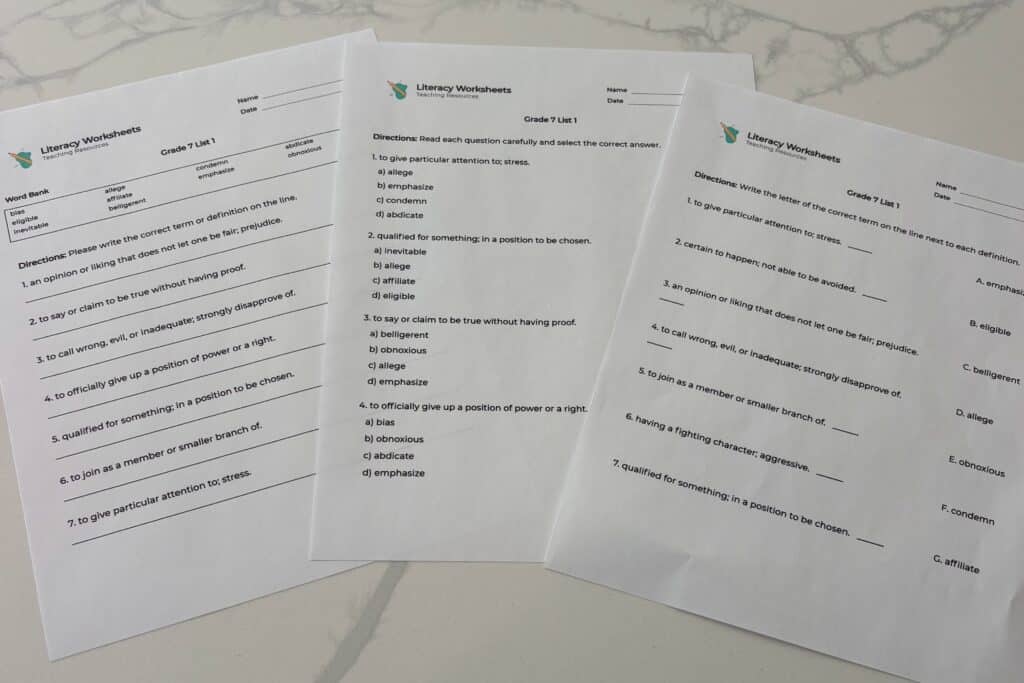
Multiple choice and matching get a bad reputation, but they force a decision between similar options, which is closer to how a word gets used than copying a definition is. The mental work of ruling out three near-misses is real practice.
5. Use the words yourself, out loud, on purpose
If reluctant is on the list, be reluctant about things all week. Narrate it. Kids pick up words from the adults around them far more readily than from a page, and this costs nothing.
6. Bring old words back
Once a list is tested, most teachers never revisit it. Slip last month’s words into this month’s practice. Mixed review is what moves a word from recognized to owned, and it’s the step that almost always gets skipped.
What this looks like in practice
Take one list and build several different kinds of practice from it across two weeks rather than one worksheet on Monday. Matching to warm up, multiple choice to force decisions, writing to produce, flashcards for the students who need more repetitions, and a crossword when you want them working from meaning back to the word.
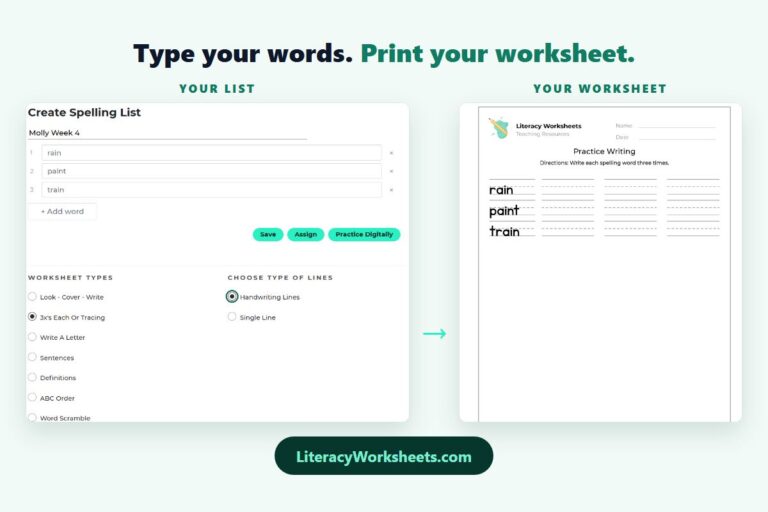
That’s why our vocabulary worksheets build from your own list rather than a fixed one: type the terms and definitions once, or look them up automatically, and generate written practice, matching, multiple choice, true or false, flashcards, sentences, definitions, and crossword puzzles from those same words. You can add a picture for each term for early or struggling readers, and print or assign it digitally.
The point isn’t the variety for its own sake. It’s that eight or ten meaningful encounters is the actual requirement, and one worksheet was never going to get there.
A note on the words themselves
If you’re choosing lists rather than following a curriculum, pick words your students will meet again in the next month of reading. Pull them from the novel you’re studying, the science unit you’re in, or the articles you use for comprehension work. A vocabulary list that has nothing to do with the rest of the week is the one students forget fastest, and the one that’s hardest to give ten encounters, because the word never naturally comes up.
None of this takes more time than the traditional routine. It takes the same time, spent differently: fewer words, better definitions, more encounters, and old words that keep coming back.